
Over time you get sick. Find a remedy. Watch your symptoms, or endure through them. Go see a doctor if it worsens. Get medication. Watch again. And maybe get better. If the process were that concise, shouldn’t the steps to better health be as succinct for intervention?
Google and Compete.com monitored their online audience for behaviors related to choosing a treatment center or care provider. In the course of monitoring keywords, search terms, clicks, page views, and other standard S.E.O. data of online users their teams found several trends in their Journey to Wellness. What they found revealed that their decisions were not made in short, intermittent searches and more along the timeline of a strategic process towards better health. How users behave online is profoundly similar to the real world, where people make decisions and choices that are functional for their situation. Follow the steps in this infographic below, and see if your own journey to wellness follows what many others are doing online. Have you ever searched for medical information and care providers online? If so, how did you begin?
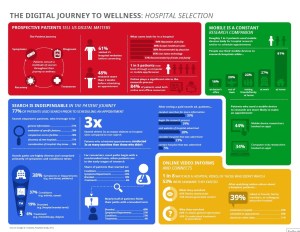 There are many who have aging parents, urgent hospitalizations, helped a family member find a doctor, or asked a friend how their experience was. Often, one encounters this experience upon a dire, critical need such as death or major illness. In a frenzy and race against time, the scramble for information in a pinch can be overwhelming. Reading medical journals, webMD articles and healthgrades.com reviews can add more stress and emotion during a difficult time. In this day, there is certainly an abundance of information about medicine to overwhelm – all which can be made easy and simple with clear direction and focus. Empowering yourself and your family with knowledge about healthcare, far in advance of when it is needed, allows one to make the right choice, at the right time. When was the last time you have gone through a crucial search for a provider that turned out well (or not)? Share your thoughts for an open discussion about the search process and what your outcomes were.


